
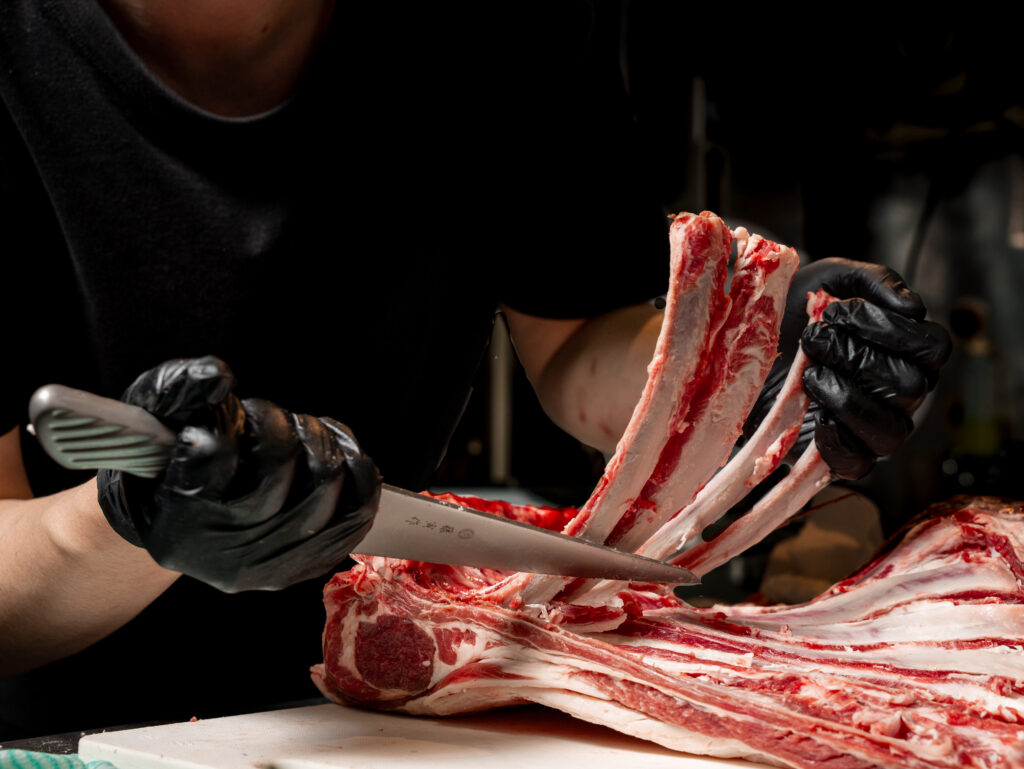
When people hear “Japanese-raised sheep meat,” they may imagine something rare, premium, or simply better than imported sheep meat.
It is certainly rare.
According to Japan’s Ministry of Agriculture, Forestry and Fisheries, domestic sheep-meat production is 93 tonnes, compared with 20,537 tonnes of imports. Domestic production accounts for only about 0.5% of the combined total.
But after actually working with Japanese-raised sheep, what interests us most is not simply the fact that it is rare.
Hitsuji Gumi, the sheep-meat specialty brand behind Azabu no Hitsuji and Ichigaya no Hitsuji, has handled sheep from more than 10 domestic producers and suppliers, mainly in Hokkaido as well as other regions including Tohoku.
We sometimes buy sheep by the whole animal, and have worked not only with Japanese-raised lamb but also hogget and mutton.
One thing this experience has made very clear is:
There is no single flavor called “Japanese sheep.”
Even lamb is not all the same. Neither is hogget.
The farm, what the animals eat, the season and the length of the rearing period can all make a difference. Size and fat cover can vary considerably from one animal to another.
And once the sheep arrives at the restaurant, there is still a great deal of work to do: removing the bones, separating the cuts and preparing each cut into portions suitable for serving.
This article looks not only at why Japanese-raised sheep meat is so rare, but also at the differences we see in practice from the moment a whole animal arrives until the meat reaches the plate.
What Do “Japanese-Raised Sheep Meat” and “Japanese Lamb” Mean?
In this article, “Japanese-raised sheep meat” refers to meat from sheep raised and produced in Japan.
Lamb, hogget and mutton, on the other hand, refer to stages of the animal’s growth rather than where it was raised.
So “Japanese-raised sheep meat” and “Japanese lamb” are not exactly the same thing.
Sheep raised in Japan may be lamb, hogget or mutton.
We have handled Japanese-raised hogget and mutton as well as lamb.
Hokkaido has the largest sheep population in Japan. According to the latest Ministry of Agriculture, Forestry and Fisheries figures, 13,012 of Japan’s 24,741 sheep are in Hokkaido—about 53%.
Most of the Japanese-raised sheep we have handled have also come from Hokkaido.
But being from Hokkaido does not mean they all taste the same.
Different farms have different approaches to raising sheep, and even animals from the same farm are not identical.
Origin is one piece of information that helps us understand an animal.
It does not determine the flavor by itself.
Only About 0.5% of Sheep Meat Supplied in Japan Is Domestic
The main reason Japanese-raised sheep meat is described as rare is simple: very little is produced.
According to the Ministry of Agriculture, Forestry and Fisheries report “Situation Surrounding Sheep and Goats” (August 2026), domestic sheep-meat production is 93 tonnes, while imports total 20,537 tonnes.
| Item | Quantity / Share |
|---|---|
| Domestic production | 93 tonnes |
| Imports | 20,537 tonnes |
| Domestic production + imports | 20,630 tonnes |
| Domestic share | Approx. 0.5% |
| Main import origins | Australia, New Zealand |
Japan has 24,741 sheep across 960 holdings.
Compared with beef, pork and chicken, sheep meat is produced and distributed on a much smaller scale.
That means Japanese-raised sheep meat cannot always be purchased year-round in exactly the same cuts, weights and specifications.
Imported sheep meat, meanwhile, is what makes it possible to eat sheep meat regularly in Japan.
Australia and New Zealand are the main sources, and their stable supply allows restaurants like ours to serve sheep meat consistently.
Domestic and imported sheep meat are not substitutes where one is automatically better than the other.
They play different roles.
How Does Japanese-Raised Sheep Meat Differ from Imports?
Some people assume:
“Japanese sheep meat is mild, while imported sheep meat smells strong.”
Our experience tells us the difference is not that simple.
Some Japanese-raised sheep have a very distinct sheep aroma, while some imported lamb is mild and approachable.
Flavor and aroma are not determined by domestic versus imported alone.
Age, farm, feed, rearing period, fat cover, cut and individual variation all contribute.
From a restaurant’s point of view, one of the biggest differences is what happens after the meat is purchased.
With much of the imported lamb we use, we can select the cuts and specifications we need and obtain them relatively consistently.
Japanese-raised sheep, on the other hand, may arrive as a whole animal.
When that happens, we first have to look at the animal itself.
How large is it?
How much fat does it carry?
Which cuts should be served, and in what form?
Rather than deciding whether domestic or imported meat is “better,” we think it makes more sense to look at what kind of sheep is actually in front of us.
What We Learned from Sheep from More Than 10 Domestic Producers and Suppliers
When we first began working with Japanese-raised sheep, we placed more weight on the word “domestic” than we do today.
The more animals and producers we worked with, the more our perspective changed.
Two lambs can be very different in size.
The same is true of hogget.
Different farms use different feeds and raising methods.
Even within the same farm, the season and the length of the rearing period can affect the size of an animal and the way fat develops.
With lamb and hogget in particular, handling whole animals makes those differences in size very easy to notice.
In the mutton we have handled, because the animals are already fully grown, differences in size related to growth stage have generally felt less pronounced than with lamb or hogget.
That does not mean mutton is all the same.
Flavor, texture, the taste of the meat and fat cover still vary from animal to animal.
That is why age category alone cannot tell you exactly what a sheep will taste like.
After handling sheep from more than 10 domestic producers and suppliers, we have come to feel that:
Rather than saying “Japanese sheep is delicious,” it is more natural to say, “This sheep is delicious.”
Origin matters.
The producer matters.
Age matters.
But in the end, what we work with is the individual animal in front of us.
We look at it, touch the meat, cut it and cook it.
Some things only become clear at that stage.
When a Whole Sheep Arrives, the Work Is Just Beginning
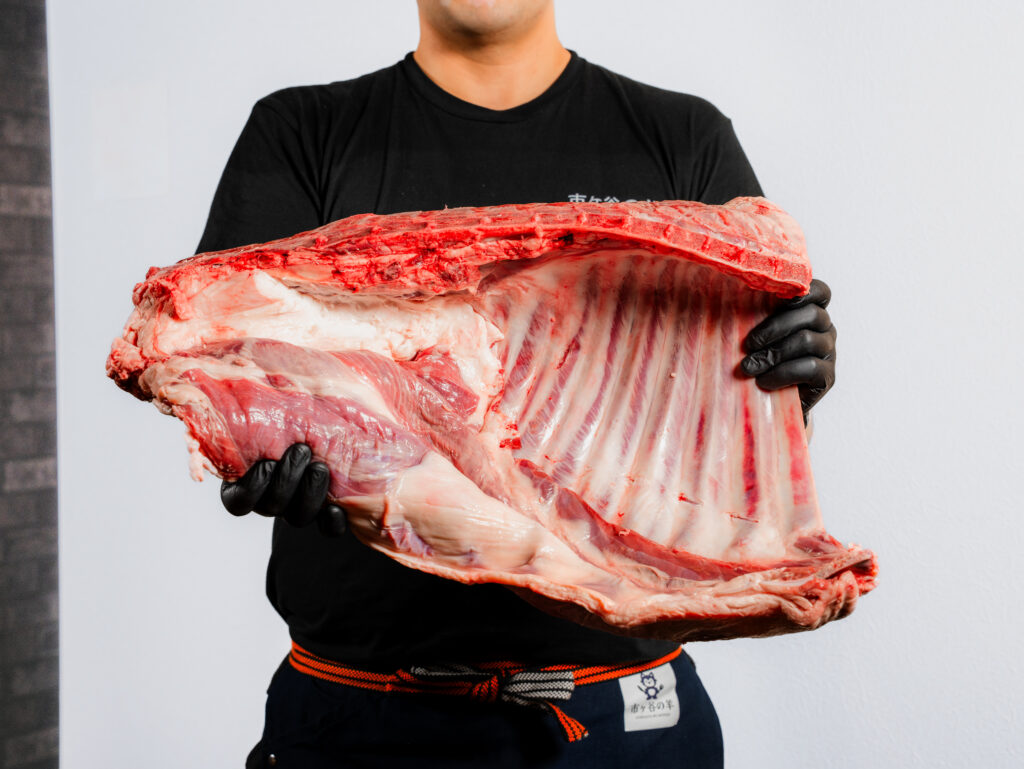
Buying a whole sheep does not mean it is immediately ready to be served as Jingisukan.
At Hitsuji Gumi, there are times when we receive a whole sheep and debone it in the restaurant, separate it into individual cuts, and then trim and portion those cuts for service.
Deboning Is More Than Just Removing the Bones
Deboning means separating the meat from the bones.
It sounds simple, but doing it cleanly takes practice.
The meat has to be worked away along the shape of the bones. If the job is rough, usable meat is left behind on the bone.
That directly affects yield.
So the aim is to remove the bones cleanly while leaving as little meat behind as possible.
Different-Sized Animals Cannot Be Handled Exactly the Same Way
Even within lamb or hogget, whole animals can differ considerably in size.
If the size is different, the frame, muscle development and fat cover will not be identical either.
The basic process remains the same, but we work according to the condition of each animal in front of us.
We debone and break the carcass down cut by cut while paying attention to its size and condition.
Work Quickly, but Cleanly
Deboning is not a job where taking as much time as possible is necessarily better.
We try to work efficiently so the meat is not kept at room temperature or exposed to the air any longer than necessary.
At the same time, rushing and leaving meat on the bones defeats the purpose.
Both speed and precision matter.
The Work Continues After the Bones Come Out
Deboning is only one stage.
After the bones are removed, the carcass is separated into cuts such as shoulder, loin and leg.
Each cut is then trimmed and portioned into a form that can actually be served to guests.
Remove the bones.
Separate the cuts.
Trim each cut.
Portion it for service.
There are many steps between a whole sheep arriving at the restaurant and the meat reaching the plate.
It is also possible for sheep to be deboned and separated into individual cuts before shipment.
From what we have seen in the industry, it is not unusual for Jingisukan restaurants to buy sheep meat already separated into cuts rather than deboning a whole carcass in the restaurant.
Working from a whole animal ourselves means that we directly see its size, fat cover and the way meat sits on the frame.
We look at the animal that has arrived and decide how to turn it into something we can serve.
That is one of the things you only really see when working with sheep by the whole animal.
We Change the Serving Cut Based on the Cut and the Meat
Even after the meat has been broken down into individual cuts, we do not simply slice everything to the same thickness.
Shoulder loin, loin and leg differ in texture and fat content.
Some cuts are more enjoyable a little thicker, allowing the texture and flavor of the meat to come through.
Others may be easier to eat when sliced somewhat thinner.
Of course, every restaurant has its own approach to exactly how thick each cut should be.
At Hitsuji Gumi, rather than relying only on a fixed rule such as “this cut must always be this thickness,” we also look at the characteristics and condition of the meat in front of us.
If the animal is a different size, the amount and shape of meat available from the same cut will also be different.
If the fat cover is different, the eating experience changes too.
Buying a whole sheep is therefore about much more than buying an unusual ingredient.
We look at the sheep.
Remove the bones.
Separate the cuts.
Trim the meat.
Choose how to portion each cut.
Only then is it ready to serve.
For us, all of those steps are part of working with sheep meat.
Summary | The Appeal of Japanese-Raised Sheep Meat Is More Than Rarity
Japanese-raised sheep meat accounts for only about 0.5% of sheep meat supplied in Japan.
It is genuinely rare.
But rarity alone is not what makes it interesting to us.
Even lamb differs from lamb.
Hogget differs from hogget.
The farm, feed, season and length of the rearing period can affect size and fat cover.
When an animal is bought whole, it then has to be deboned, broken down into cuts and portioned for service.
Going through that process makes the differences between individual sheep even more visible.
Sheep meat cannot be fully understood from the name of its place of origin alone.
Instead of stopping at the word “Japanese,” we want to look at what kind of sheep each animal actually is.
That makes sheep meat far more interesting.
Hitsuji Gumi mainly serves imported lamb, while also working with Japanese-raised sheep, hogget and mutton when available.
Availability changes with the season and supply, so please check with each restaurant if you are interested in trying Japanese-raised sheep meat.
Azabu no Hitsuji
A sheep-meat specialty restaurant in Azabu-Juban where you can enjoy Jingisukan and a range of sheep meat.
Ichigaya no Hitsuji
A sheep-meat specialty restaurant in the Ichigaya and Kojimachi area where you can enjoy Jingisukan and sheep meat.