
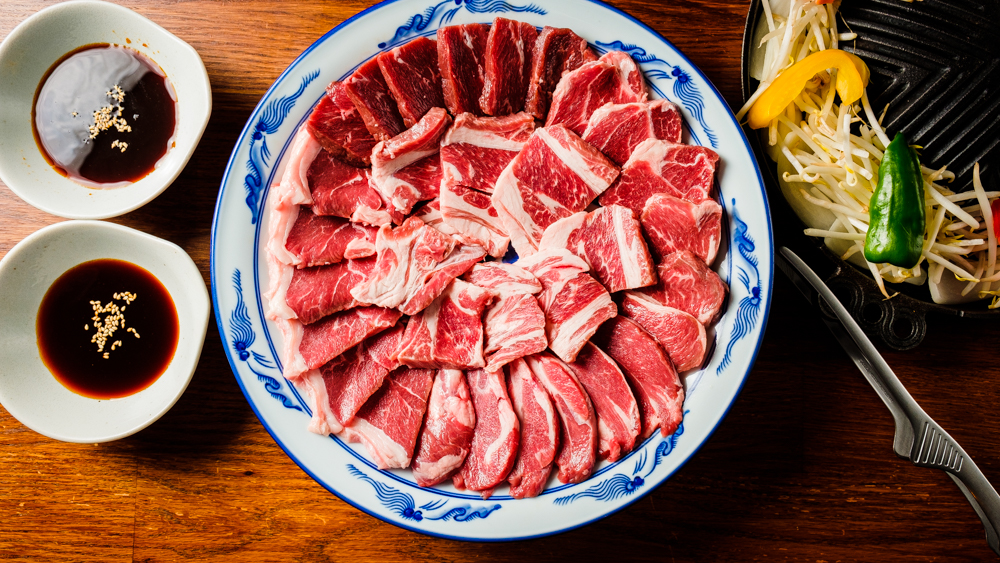
Jingisukan is not defined by lamb alone.
The freshness and condition of the meat are, of course, extremely important.
But for a Jingisukan restaurant, one of the things that gives each restaurant its own character is the sauce.
Some restaurants grill unseasoned lamb and dip it in sauce afterward, while others season or marinate the meat before grilling.
The condiments served alongside it and the recommended way to eat it also vary from restaurant to restaurant.
In this article, we explain from the perspective of a lamb specialist the difference between dipping-style and marinated Jingisukan, why sauce matters, and how to enjoy lamb in different ways.
Jingisukan sauce comes in two main styles: dipping and marinated
There are two common ways to enjoy Jingisukan: dipping-style and marinated-style.
Dipping-style
The lamb is grilled without strong seasoning and dipped in sauce just before eating.
This makes it easier to appreciate the aroma, umami, fat and differences between cuts of lamb.
You can also adjust the amount of sauce and condiments as you eat.
Marinated-style
The lamb is seasoned or marinated in sauce before it is grilled.
The meat and sauce become one flavor, and the sauce develops additional roasted aromas as it cooks.
Both styles are enjoyed in Hokkaido. Dipping-style Jingisukan is commonly associated with areas such as Sapporo, while marinated Jingisukan developed strongly around areas such as Takikawa.
| Dipping-style | Marinated-style | |
|---|---|---|
| When sauce is used | After grilling | Before grilling |
| Flavor of the lamb itself | Easier to taste | More integrated with the sauce |
| Adjusting the flavor | Easy to change while eating | Flavor is largely set before grilling |
| How to enjoy it | Meat, cuts and condiments | Meat and seasoning together |
Neither style is more correct or inherently better.
The best choice depends on how you want to enjoy the lamb.
Sauce is an important part of a Jingisukan restaurant
From our perspective as a lamb specialist, the sauce can influence the identity of a restaurant just as much as the freshness and condition of the meat.
Even with the same lamb, the impression can change depending on whether the sauce is:
- sweet
- strongly soy-sauce based
- made with fruit
- aromatic with garlic or ginger
- light and refreshing
There is no single standardized Jingisukan sauce used everywhere.
Each restaurant has its own approach and balance.
That is why enjoying the sauce itself is also part of discovering the character of a Jingisukan restaurant.
What is Jingisukan sauce made from?
Recipes differ between restaurants and households.
Common ingredients may include a soy sauce base combined with:
- garlic
- ginger
- sweetness
- fruit
- acidity
- sesame
- spices
One example introduced by Japan’s Ministry of Agriculture, Forestry and Fisheries uses ingredients such as soy sauce, garlic, ginger, apple and pear.
This is only one example.
Even when similar ingredients are used, differences in balance, sweetness, acidity, aroma and concentration can create completely different sauces.
For that reason, the sauce itself can become part of a restaurant’s identity.
Sauce is not only there to hide the aroma of lamb
Some people may think:
“Lamb has a distinctive smell, so it needs a strong sauce.”
Garlic, ginger, fruit and spices can certainly change how the aroma of lamb is perceived.
However, from the perspective of a lamb specialist, sauce should not be used simply to cover up the condition of the meat.
The quality of lamb also depends on factors such as:
- the quality of the meat itself
- freshness and condition
- fat
- storage
- preparation
- grilling
Good lamb has its own natural umami and aroma.
We see sauce not simply as something that removes that aroma, but as something that brings out another dimension of the lamb’s flavor.
Dipping sauce makes it easier to appreciate the lamb itself
With dipping-style Jingisukan, lamb without strong seasoning is grilled first and then dipped in sauce.
This makes it easier to notice:
- the aroma of lamb
- the umami of the meat
- the sweetness of the fat
- differences in texture between cuts
- differences between lamb, hogget and mutton
When eating fresh lamb or comparing several cuts, starting without a strong sauce can make the differences between the meats easier to recognize.
Another advantage of dipping-style Jingisukan is that you can gradually add sauce and condiments while eating and change the flavor of the same meat.
Related article
How to grill jingisukan well: when to turn the lamb, and how not to overcook it
Learn when to turn the lamb and how to avoid overcooking it for the best texture and flavor.
Marinated Jingisukan treats the sauce as part of the dish
With marinated Jingisukan, the lamb is seasoned before it is grilled.
The major difference from dipping-style Jingisukan is that the meat and sauce are treated as one dish.
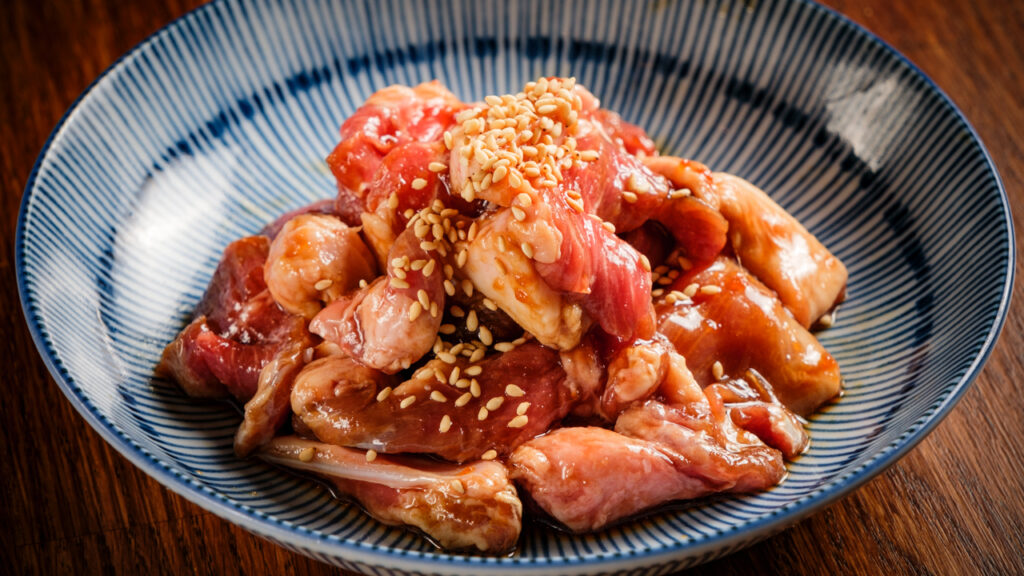
Sweetness, saltiness and aromatic ingredients combine with the meat, while grilling creates additional roasted aromas.
On a dome-shaped Jingisukan pan, fat and sauce can run down toward the vegetables cooking around the lower part of the pan.
This makes it possible to enjoy not only the meat, but also the sauce and vegetables as part of the overall dish.
Condiments also give each restaurant its own character
When visiting different Jingisukan restaurants, sauce is not the only thing worth paying attention to.
The condiments served with the sauce can also vary greatly by restaurant.
For example:
- garlic
- ginger
- black pepper
- cumin
- green chili pepper
Garlic and ginger change the aroma and richness.
Pepper and green chili add stimulation and sharpness.
Cumin creates yet another aromatic combination with lamb.
Even with the same sauce, adding a single condiment can change its aroma, heat and finish.
Being able to change the flavor as you eat and create your own preferred combination is another pleasure of Jingisukan.
When comparing Jingisukan restaurants, look not only at the lamb they serve, but also at the sauce, condiments and the way the restaurant encourages you to enjoy them.
Lamb, hogget and mutton can feel different with sauce
The aroma, fat and strength of flavor differ depending on the age of the sheep and the cut.
Lamb
Lamb is generally tender and has a relatively mild sheep aroma.
Especially with fresh lamb, starting with a simple preparation makes it easier to appreciate the natural umami and aroma.
Hogget
Hogget develops more pronounced sheep flavor and umami than lamb, giving the meat greater presence.
It can be enjoyable both simply seasoned and together with sauce and condiments.
Mutton
Mutton has a fuller, more distinctive sheep aroma and flavor.
It can stand up well to stronger sauces and condiments, while good-quality mutton can also be enjoyed simply grilled for its own aroma.
The important point is not to erase the character of the meat with sauce, but to decide how you want to enjoy that particular lamb.
At Hitsujigumi, we recommend tasting the first piece with salt
Hitsujigumi also offers seasoned Jingisukan, but our basic style is dipping sauce after grilling.
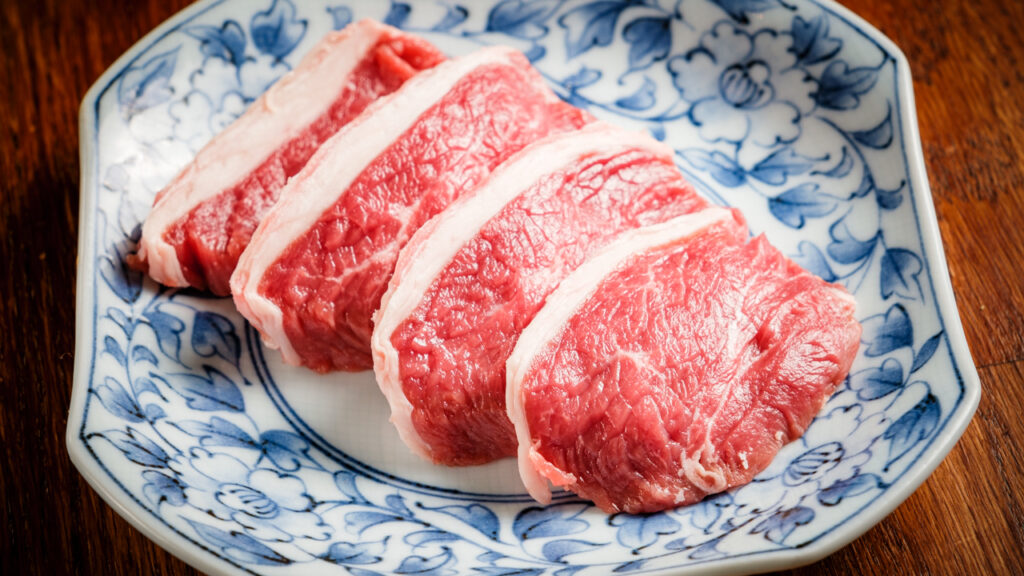
However, we do not recommend putting the first piece straight into the sauce.
For the first piece, we recommend:
Enjoy it simply with salt.
This lets you experience the lamb’s:
- flavor
- umami
- aroma
- fat
- texture
With fresh lamb in particular, tasting it before adding other flavors makes the natural characteristics of the meat easier to understand.
Then “build” your dipping sauce with condiments
After enjoying the first piece simply, move on to the sauce.
Hitsujigumi’s house sauce contains fruit, but the specific ingredients and recipe are not disclosed.
First, taste the sauce as it is.
Then add condiments according to your preference, such as:
- garlic
- ginger
- black pepper
- cumin
- green chili pepper
At Hitsujigumi, we think of this as “building” your own dipping sauce.
Add garlic.
Change the aroma with ginger.
Add pepper or green chili for extra stimulation.
Use cumin to explore how its aroma works with lamb.
As you gradually add condiments while eating, the sauce can taste different at the end of the meal than it did at the beginning.
Even the same lamb can feel different as the dipping sauce evolves.
Our recommended progression is:
First taste the lamb itself with salt, then use sauce and condiments to discover the flavor combination you enjoy most.
Enjoy the restaurant through the sauce, not only the meat
When choosing a Jingisukan restaurant, many people focus on where the lamb comes from, how fresh it is, or whether it is lamb or mutton.
Those things are certainly important.
But the differences between restaurants are not limited to the meat.
Sauce, condiments, grilling and the way the restaurant recommends eating the lamb are all part of its Jingisukan.
Even the same lamb can feel different from one restaurant to another.
When trying different Jingisukan restaurants, paying attention to the sauce as well as the meat can make lamb even more interesting.
Summary | Sauce is an important part of a Jingisukan restaurant’s flavor
Jingisukan has two representative styles:
dipping grilled lamb in sauce afterward
and
seasoning or marinating the lamb before grilling.
For a Jingisukan restaurant, sauce is an important element alongside the freshness and condition of the meat.
Condiments and recommended eating styles add even more personality.
At Hitsujigumi, we recommend tasting the first piece with salt so you can appreciate the flavor, umami and aroma of the lamb itself.
Then, add garlic, ginger, pepper, cumin, green chili and other condiments to the house sauce and build the dipping sauce to your own taste.
We value both experiences:
enjoying the lamb itself,
and discovering the flavor combination that suits you best.
When eating Jingisukan, pay attention not only to the meat, but also to:
“What does this restaurant’s sauce taste like?”
and
“How does the flavor change with different condiments?”
Related article
What Is Jingisukan? What Meat Is Used? How to Eat It, the Pan, and How It Differs from Yakiniku
Azabu no Hitsuji
A lamb specialty restaurant in Azabu-Juban, serving Jingisukan and a variety of sheep meat.
Ichigaya no Hitsuji
A lamb specialty restaurant in the Ichigaya and Kojimachi area, serving Jingisukan and a variety of sheep meat.
References
- Ministry of Agriculture, Forestry and Fisheries of Japan — “Jingisukan | Traditional Foods of Japan”
- Ministry of Agriculture, Forestry and Fisheries of Japan — “Jingisukan / Genghis Khan, Hokkaido | Our Regional Cuisines”
- Hokkaido Prefectural Library — “140 Years of Sheep and Hokkaido / Stories Around Jingisukan”